The global policy landscape is currently undergoing a surreal shift, driven largely by the assertive actions of the Trump administration.
From the recent intensification of interests in Venezuela and vocal strategic manoeuvres regarding Greenland, through the recursive imposition of anti-trade import tariffs and export embargoes, to the cessation of USAID operations on 1 July 2025, the “America First” doctrine is redefining international relations in unprecedented fashion. Nigeria has found itself at the centre of the global geopolitical tension.
The Trump administration recently designated Nigeria as a country of particular concern (CPC), citing systemic religious persecution.
Simultaneously, the U.S. military has taken direct action on Nigerian soil, notably conducting intelligence-led airstrikes against ISIS-linked camps in Northern Nigeria.
These moves signal a dual-track approach: diplomatic pressure coupled with aggressive, direct counter-terrorism intervention.

Right from the first week of its current tenure, the Trump Administration announced cessation of funding or exit from 66 international organisations, including the World Health Organisation (WHO) and United Nations (UN) agencies and programmes.
By February 2025, the Administration had announced an imminent end to USAID, accusing it of diverting funds and misaligning with U.S. interests.
When it finally shut down on 30 June 2025, 83% of USAID’s programmes across the world had been cancelled, and the remaining programmes moved to the US Department of State, where they face uncertainties.
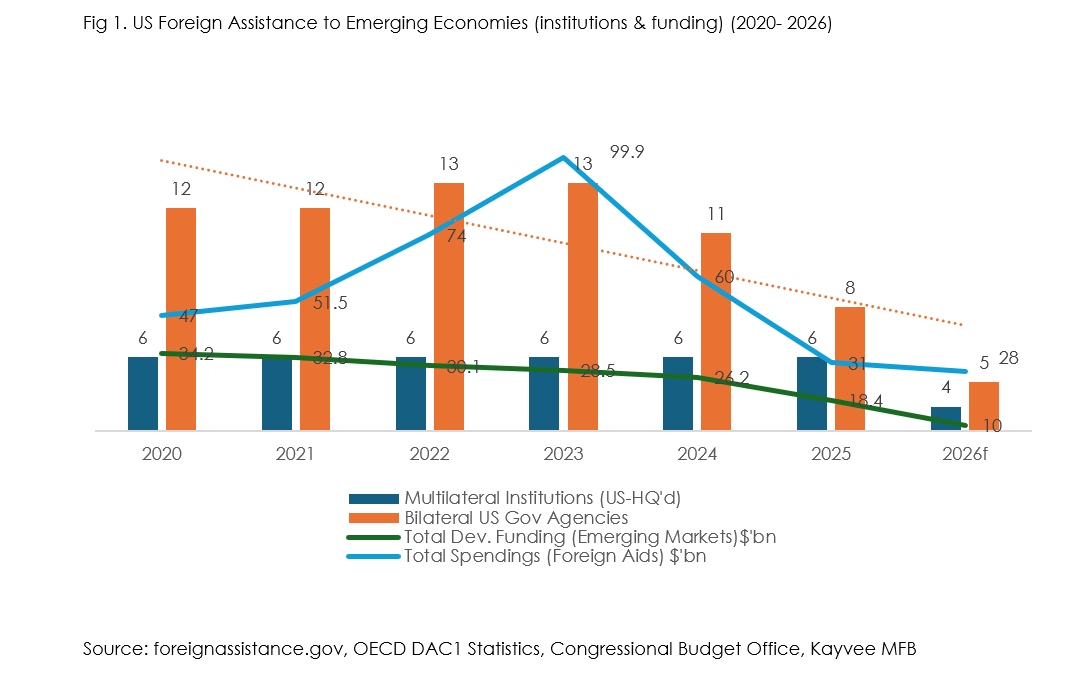
According to foreignassistance.gov[1], US foreign aid obligations had dropped from $82 billion on 17,000 activities across 213 countries in 2024 to $20 billion across 4,900 activities across 186 countries by the end of 2025.
The aftermath of the cessation of USAID, long seen as the primary vehicle for advancing development in emerging economies, has seen a sharp decline in low-scale investment across Africa, a continent that has historically relied on USAID funds for impact and sustainable development. The chart below illustrates a decisive shift in US foreign policy.
As the Trump administration prioritises domestic ‘America First’ fiscal consolidation, we observe a sharp contraction in traditional developmental aid, a downward trajectory that is expected to define the 2026 fiscal landscape.
While Eurozone and Asian partners have historically maintained consistent development portfolios, the global surge in far-right movements is redrawing the aid landscape.
We anticipate that this ‘nativist’ ideology may soon dominate European policy centres, mirroring the US shift toward prioritising domestic fiscal interests over international cooperation.
This transition is already fuelling ‘moral misalignment’ debates, in which development funding is increasingly being leveraged as a tool of political pressure to influence social legislation in recipient nations.
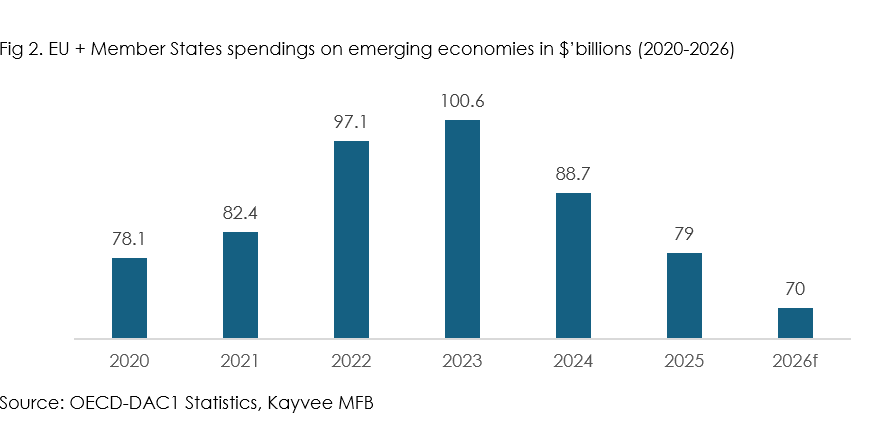
As economic dependency inevitably translates to political dependency, the current funding vacuum should serve as a wake-up call. We expect emerging economies to finally take off the shackles of dependency and develop sustainable financing strategies.
A clear example of this resilience is seen in Afreximbank; despite recent ratings downgrades, the institution continues to advance the cause of African trade financing, proving that African-owned agencies can sustain their unique economic and shared values.
Only Africa can genuinely develop Africa. By embracing budgeting, performance monitoring, and independent financial structures, the continent can turn this crisis of aid into an era of true sovereignty.
Nigeria’s Green Pivot: Bridging High Ambition and Structural Reality
At the 2026 Abu Dhabi Sustainability Week held between 11 and 17 January 2026, President Bola Ahmed Tinubu signalled a decisive shift in Nigeria’s economic strategy, unveiling a roadmap to position the country as a global destination for green investment.
The new approach emphasises market-led solutions, technology and private capital as key drivers of sustainable growth, which is consistent with Nigeria’s Net-Zero 2060 ambition.
In 2025, Nigeria unveiled a national carbon activation policy (NCAP) to unlock $2.5 to $3 billion annually over the next decade by recognising carbon as a tradable asset.
It is expected to fund Nigeria’s energy transition, attract green investment and create jobs that directly impact local communities.
A national carbon registry (which ensures international-grade transparency) is at the core of the national carbon market framework (NCMF) and is expected to serve as the means of tracking and managing carbon credits.
The implementation of the NCAP and the inauguration of the National Council on Climate Change (NCCC) are expected to provide regulatory clarity for investors and give impetus to the actualisation of the goals of the federal government.
In relation to technology and Nigeria’s Net-Zero 2060 ambition, the government is already prioritising AI-driven energy efficiency and grid optimisation, supported by the Electricity Act 2023, to expand power access to underserved communities, healthcare facilities and small businesses.

Institutional foundations are also being strengthened through the operationalisation of the climate change fund, dedicated budgetary support for the NCCC and updated nationally determined contributions (NDCs) submitted to the UN in 2025.
However, structural realities remain. Nigeria’s continued reliance on carbon-intensive imports, affordability-driven demand for used fossil-fuel vehicles, weak ESG enforcement and limited sustainability adoption by businesses all pose headwinds.
In the near term, external pressures from investors, export markets and development financiers are likely to drive climate alignment faster than domestic demand.
Navigating the New Tax Regime: Shielding the Vulnerable or Shifting the Burden?
The commencement of the new tax regime has introduced a wave of ambiguity, leaving citizens and business owners alike seeking clarity. While much of the national discourse focuses on macro-economic shifts, our primary concern remains the financially underserved, small and medium enterprises (SMEs) and vulnerable groups.
This climate has prompted a surge in SMEs seeking professional counsel on tax optimisation and structural pivots, such as transitioning from Business Name registrations to Limited Liability companies.
The Investor Dilemma- There is a growing consensus that the current reforms, specifically the elevated capital gains tax (CGT) and withholding tax on local investment instruments, may inadvertently disincentivise investors.
The Threshold Reality Gap- On the surface, the regime offers a “fair play” provision for the underserved by setting a tax-exempt cap for low-income earners (under ₦800,000) and small businesses (under ₦100 million annual turnover).
However, these figures fail to account for the harsh reality of inflation. Many SMEs now exceed the ₦100 million threshold not due to organic growth, but because of the depreciating value of currency and rising cost of goods.
The Invisible Tax Burden- Furthermore, being “shielded” by a threshold does not mean being protected from the impact.
Small businesses and low-income earners sit at the end of the supply chain; they will inevitably bear the brunt of the tax burden as larger corporations pass on their increased costs through price hikes.
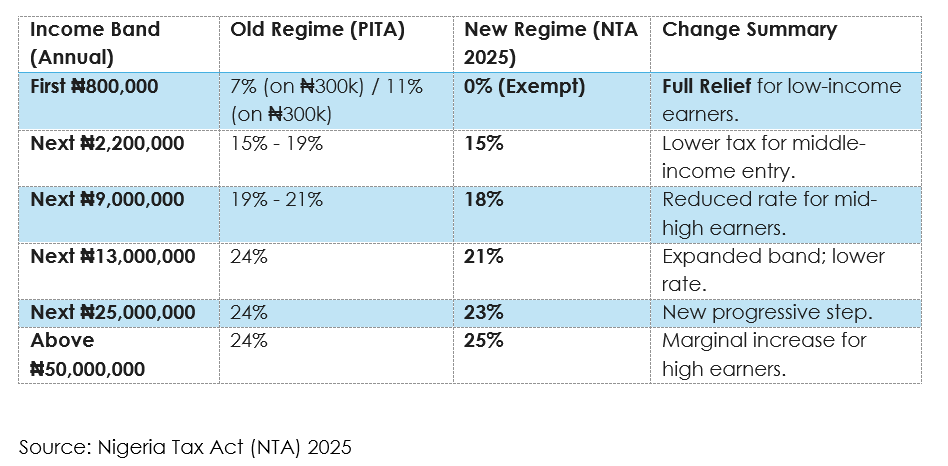
Personal Income Tax (PAYE) Comparison
The new regime removes the consolidated relief allowance (CRA) and replaces it with a higher tax-free threshold and wider bands for middle-income earners.
Key Business & Corporate Tax Shifts
The new regime streamlines small business exemptions and replaces multiple “nuisance” taxes with a single levy.
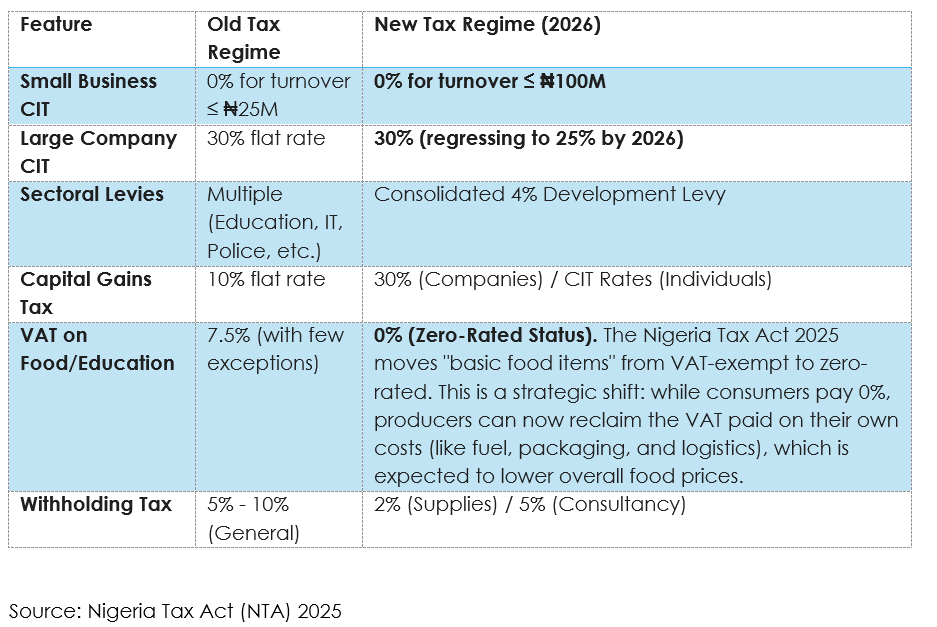
The Way Forward – Value Added Tax (VAT) continues to be a primary source of complexity for traders, particularly regarding its application and calculation within diverse trade transactions.
For these reforms to succeed without crushing the informal sector, the tax authorities must prioritise continuous orientation. This should be a collaborative effort involving key stakeholders, particularly bankers, to bridge the information gap.
Festive Excess vs. Financial Integrity: Addressing the “Detty December” Credit Risk
December in Nigeria is a period of heightened economic activity, characterised by the return of the diaspora and a national surge in recreational spending. While “Detty December” bolsters the hospitality and tourism sectors, it simultaneously presents a significant challenge to the credit ecosystem and personal financial health.
The Visibility of Irresponsible Spending – Of particular concern is the “spraying” culture and luxury consumption by individuals with active debt obligations. For lenders, this visual display of excess serves as a red flag.
When borrowers prioritise high-end festivities over debt servicing, it forces financial institutions to adopt a more conservative and discreet posture toward new lending requests.

The January Liquidity Crunch- The repercussions of festive indulgence are most visible in the “January Hangover.” Lenders frequently experience a spike in default rates and collection bottlenecks as the new year begins.
This trend creates a domino effect: household budgets are strained, and critical payments, such as rent and school fees, are often sacrificed to cover the fiscal gaps left by December’s celebrations.

The Path to Financial Maturity- To foster a sustainable credit environment, there must be a shift in consumer behaviour. We advocate for a culture of financial restraint and heightened awareness.
By aligning festive spending with actual disposable income and honouring existing commitments, individuals can improve their creditworthiness and ensure a more stable start to the year.
Fiscal Alignment: Bridging the Gap Between National Policy and SME Growth
While the national and corporate budgets are viewed as the cornerstones of financial discipline in the public and private sectors, respectively, a significant gap exists at the grassroots level.
Many individuals and small businesses operate without formal targets, often recycling outdated methods rather than adopting a vision-driven approach.
This lack of a structured roadmap is a primary factor in the high mortality rate of emerging enterprises. Without a clear plan, these businesses struggle to scale up, highlighting a critical area where the underserved need urgent support and orientation.

To change this trajectory, business owners must view the federal budget as a vital indicator.
By analysing the government’s objectives, businesses can identify where the money will flow and how specific sectors can position themselves to benefit from national spending.
Growth is the ultimate objective of any entity in a progressive economy. However, for underserved businesses to transition from survival to sustainability, they must move away from informal habits.
We are committed to helping these businesses embrace scaling by providing the necessary orientation on budgeting and performance monitoring. Only by aligning individual vision with national economic direction can we foster a culture of trust and long-term institutional success.
Kayvee Impact Stories
Coming soon: A look at the lives changed by Kayvee MFB. Our next edition will feature ‘Impact Stories’—a collection of customer journeys and evidence of how our support is creating a more inclusive financial future for everyone.